Hereditary hemochromatosis (HHC) is a hereditary metabolic disorder caused by HFE gene mutation with an autosomal recessive type of inheritance and incomplete penetration (which means it does not have to always be shown in a phenotype). It is one of the most common hereditary disorders with an indicated prevalence of the majority C282Y mutation in a homozygous condition in 1:300–400 in the Caucasian population.
HFE protein is bound to beta-2-microglobulin and this complex blocks the transferin receptor in the cells of the duodenum. There is no receptor blockade in the complex consisting of the mutated form of the protein which results in permanent increased iron absorption from the gastrointestinal tract into the blood stream and its accumulation in parenchymatous tissues and organs, especially in liver, pancreas, heart, gonads and in the skin. These organs can then be irreversibly damaged.
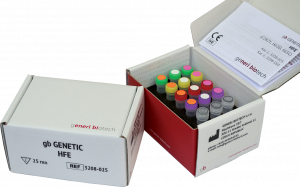
Parameters of the real-time PCR diagnostic kit
- ready-to-use assay
- sample concentration 1-100 ng/µl
- positive and negative controls included
- FAM and HEX channels detection
- identical amplification profile as gb HEMO, gb GENETIC, gb PHARM kits

 ENG
ENG  CZE
CZE 




 gb SG PCR Master Mix