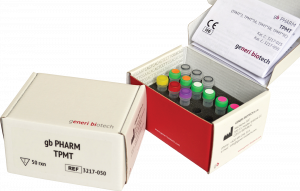
gb PHARM TPMT
Detection method:
allelic discrimination
This in vitro diagnostic kit is intended for detection of TPMT*2, TPMT*3A, TPMT*3B and TPMT*3C in TPMT gene in human genomic DNA by realtime PCR method (allelic discrimination). The kit allows the determination of haplotypes TPMT*2, TPMT*3A, TPMT*3B and TPMT*3C in homozygous or heterozygous form. The kit does not distinguish genotype *1/*3A (two mutations in cis form) from 3B*/*3C (the incidence of the composite heterozygote *3B/3C* is unlikely in Caucasians).
Clinical implications of the CE IVD kit
Thiopurine S-methyltransferase (TPMT) is an essential enzyme for biodegradation of thiopurines. Antitumor drugs thioguanine and mercaptopurine, related to thiopurines, are used especially in hematooncology. Another thiopurine, azathioprine, is an immunosuppressive agent intended for the treatment of autoimmune diseases and prevention of transplant rejection.
The thiopurine drug side effects include neurotoxicity, hepatotoxicity, myelosuppression, mucositis and others. The biotransformation activity of the TPMT enzyme may be reduced due to the presence of the single nucleotide polymorphisms in the coding region of the TPMT gene. The most studied deficient alleles are TPMT*, TPMT*3A, TPMT*3B and TPMT*3C. Limited thiopurine biotransformation leads to the escalation of side effects of treatment. Upon detection of heterozygote it is recommended to reduce the dose of the drug to 30-70%, in the case of the homozygote and the composite heterozygote it is better to choose an alternative treatment.
Parameters of the diagnostic kit
- ready-to-use assay
- sample concentration 1-100 ng/µl
- positive and negative controls included
- FAM and HEX channels detection
- identical amplification profile as gb HEMO, gb GENETIC, gb PHARM kits
Validated for:
ABI 7500/7500 Fast (ABI)
AriaMx (Agilent Technologies)
CFX96/96Touch (Bio-Rad)
iCycler iQ5 (Bio-Rad)
Light Cycler 480/Cobas z480 (Roche Diagnostics)
MIC (BMS)
QuantStudio 5 (Applied Biosystems)
RG 3000 (Corbett Research)
RG 6000/Q (Corbett Research/Qiagen)

 ENG
ENG  CZE
CZE 


 Kit for isolation of DNA from body fluids