Amino C3Sp
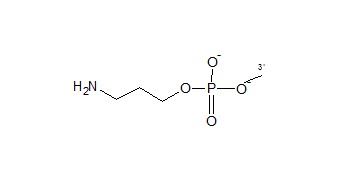
The amino group is bound to the 5' end of the oligonucleotide sequence by a three carbon spacer. It is used as an intermediate for further oligo modifications (attachment to special surfaces, conjugation).
Our modified oligonucleotides cover end modifications at the 3′ and 5′ ends as well as internal positions.
We offer base analogs, spacers, fluorophores, quenchers, backbone changes and functional groups for applications such as antisense, sequencing, duplex stabilization, structural studies or click-chemistry conjugations.
All modifications are delivered with high purity and can be combined on request (where chemistry allows).
Popular modifications & use cases
Looking for labeled probes? See
RT-PCR dual-labeled probes
or browse all oligonucleotides.
The amino group is bound to the 5' end of the oligonucleotide sequence by a three carbon spacer. It is used as an intermediate for further oligo modifications (attachment to special surfaces, conjugation).
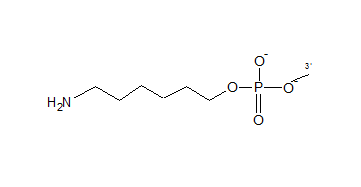
The amino group is bound to the 5' end of the oligonucleotide sequence by a six carbon spacer. It is used as an intermediate for further oligo modifications (attachment to special surfaces, conjugation).
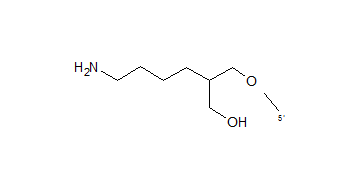
The amino group is bound to the 3' end of the oligonucleotide sequence by a seven carbon spacer. It is used as an intermediate for further oligo modifications (attachment to special surfaces, conjugation) while keeping the 5' end free for another possible modification and as a blocker of 3' polymerase extension.
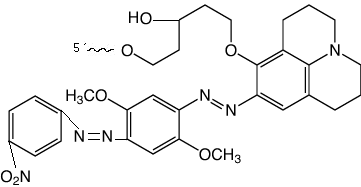
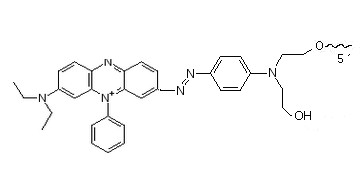
Quencher suitable for fluorophores having an emission wavelength range from 550 to 750 nm. BBQ-650 may be attached to the 5'end or the 3' end of the oligonucleotide.
A quencher suitable for fluorophores having an emission wavelength range from 480 to 580 nm. BHQ1 may be attached anywhere within the oligonucleotide sequence.
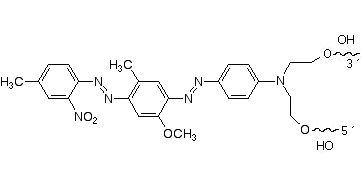
A quencher suitable for fluorophores having an emission wavelength range from 540 to 670 nm. BHQ2 may be attached anywhere within the oligonucleotide sequence.
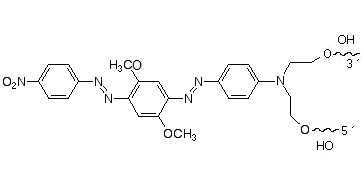
Quencher suitable for fluorophores having an emission wavelength range from 620 to 730 nm. BHQ3 may be attached to the 3'end of the oligonucleotide.
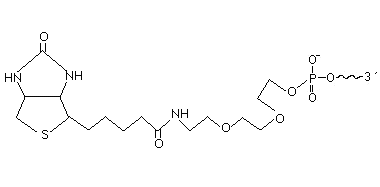
Biotin may be attached either to the 5' end or the 3' end of the oligonucleotide. The biotin molecule is separated from the 3' end by a sixteen carbon spacer.
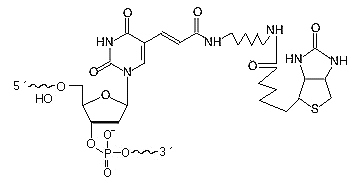
Biotin dT is attached with a six carbon spacer at position 5 of the thymine circle. Biotin dT may be attached anywhere within the oligonucleotide sequence except for the 3' end.
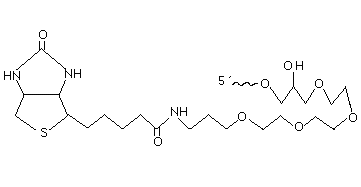
Biotin is ligated to the oligonucleotide by means of a triethylene glycol spacer (TEG), extending the distance between the oligonucleotide and the biotin by 15 atoms. Biotin-TEG may be ligated to the 3´, 5´ ends of the oligonucleotide.
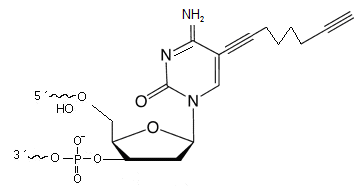
It is used for conjugations based on the click chemistry principle. C8-Alkyne-dC may be attached anywhere within the oligonucleotide sequence except for the 3' end.
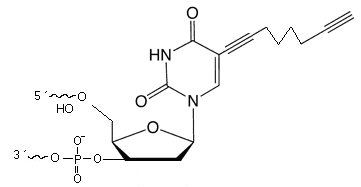
It is used for conjugations based on the click chemistry principle. C8-Alkyne-dT may be attached anywhere within the oligonucleotide sequence except for the 3' end.
Your request has been sent.
Your cycler has not been included in the list?
Send us the type of your cycler and we will find a solution for you.
Your request has been sent.
Thank you for your inquiry
Your registration has been sent.
Thank you for your inquiry