
Categories

modified oligonucleotides

modified oligonucleotides

Modified oligonucleotides – options & examples

Our modified oligonucleotides cover end modifications at the 3′ and 5′ ends as well as internal positions.
We offer base analogs, spacers, fluorophores, quenchers, backbone changes and functional groups for applications such as antisense, sequencing, duplex stabilization, structural studies or click-chemistry conjugations.
All modifications are delivered with high purity and can be combined on request (where chemistry allows).

Popular modifications & use cases

Looking for labeled probes? See
RT-PCR dual-labeled probes
or browse all oligonucleotides.

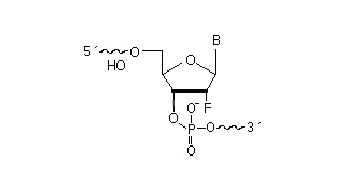
2’F-RNA

2’F-RNA 2’F-RNA

2'-F-RNA is even more stable than 2'-O-methyl-RNA. 2'-F-RNA & RNA duplexes do not activate RNase H and are more stable (with higher Tm) than RNA & 2'-O-methyl-RNA duplexes. It serves mainly for antisense applications. May be attached anywhere within the oligonucleotide sequence.
More
2’OMe-RNA

2’OMe-RNA 2’OMe-RNA

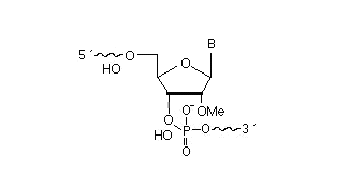
Compared to RNA 2'-O-methyl-RNA is more chemically stable (being stable against nucleases for several days). 2'-O-methyl-RNA & RNA duplexes do not activate RNase H and are more stable (with higher Tm) than DNA & RNA duplexes. It is used mainly in antisense applications. May be attached anywhere within the oligonucleotide sequence.
More
2′3′-ddC

2′3′-ddC 2′3′-ddC

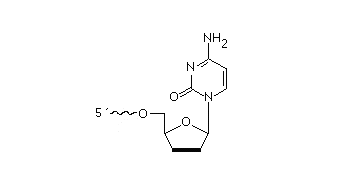
It serves as a blocker of 3' polymerase extension. 2',3'-ddC may be attached to the 3' end of the oligonucleotide.

More
5-Br-dU

5-Br-dU 5-Br-dU

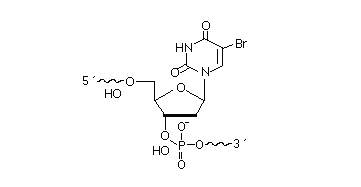
May be attached anywhere within the oligonucleotide sequence except for the 3' end. It is used for crystallographic studies of oligonucleotide structures. 5-Br-dC is photolabile, the feature which is utilized in cross-linking studies investigating protein-DNA complex structures.

More
5-I-dU

5-I-dU 5-I-dU

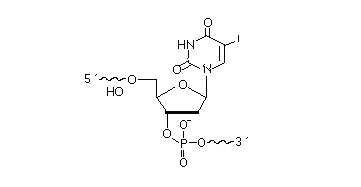
May be attached anywhere within the oligonucleotide sequence except for the 3' end. It is used for crystallographic studies of oligonucleotide structures. 5-I-dU is photolabile, the feature which is utilized in cross-linking studies investigating protein-DNA complex structures.

More
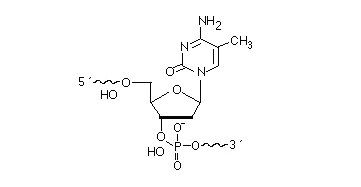
5-Me-dC

5-Me-dC 5-Me-dC

Increases duplex stability and is suitable for antisense applications. May be attached anywhere within the oligonucleotide sequence.
More
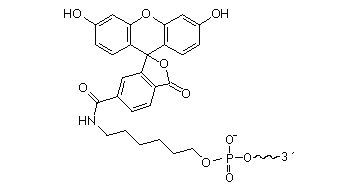
6-FAM

6-FAM 6-FAM

Denotes pure 6-carboxyfluorescein isomer. This is among the most used oligonucleotide fluorescent modifications and is compatible with the majority of fluorescent devices. 6-FAM may be attached either to the 5' end or the 3' end of the oligonucleotide.

More
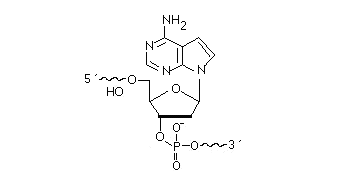
7-Deaza-dA

7-Deaza-dA 7-Deaza-dA

It is used to study oligonucleotide activity changes following alteration of the main structural component. 7-Deaza-dA may be attached anywhere within the oligonucleotide sequence except for the 3' end.

More
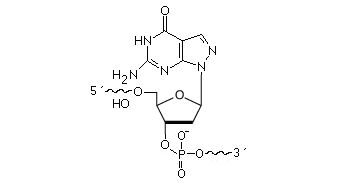
7-Deaza-8-aza-dG

7-Deaza-8-aza-dG 7-Deaza-8-aza-dG

It is used to study oligonucleotide activity changes following alteration of the main structural component. 7-Deaza-8-aza-dG may be attached anywhere within the oligonucleotide sequence except for the 3' end.

More
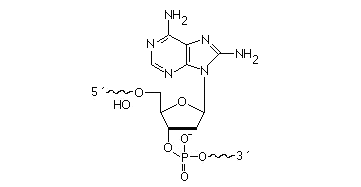
8-Amino-dA

8-Amino-dA 8-Amino-dA

May be attached anywhere within the oligonucleotide sequence except for the 3' end. 8-Amino-dA modified oligonucleotides are utilized for triplex formation, enabled by the presence of an additional amino group.

More
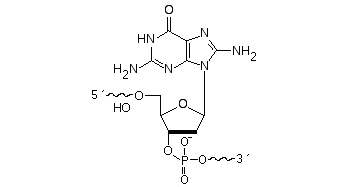
8-Amino-dG

8-Amino-dG 8-Amino-dG

May be attached anywhere within the oligonucleotide sequence except for the 3' end. 8-Amino-dG modified oligonucleotides are utilized for triplex formation, enabled by the presence of an additional amino group.

More
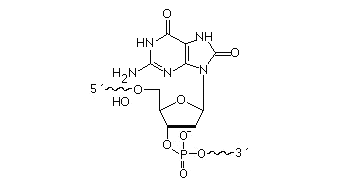
8-Oxo-dG

8-Oxo-dG 8-Oxo-dG

May be attached anywhere within the oligonucleotide sequence except for the 3' end. It is used for structural and activity studies concerning oligonucleotides carrying an 8-oxo mutation. This naturally occurs when DNA is exposed to oxidative agents or ionizing radiation.

More
Previous 1 2 3 5