



Categories

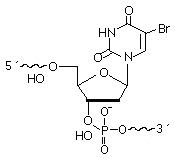
5-Br-dU

5-Br-dU

Modification by group: Cross-link bases

Position of modification: 3´, 5´, internal

May be attached anywhere within the oligonucleotide sequence except for the 3′ end. It is used for crystallographic studies of oligonucleotide structures. 5-Br-dC is photolabile, the feature which is utilized in cross-linking studies investigating protein-DNA complex structures.

5-Br-dU

Cat. No. Modification Scale Price
1170-040 5-Br-dU 40 nmol
Add to Quote
Add to Quote
1170-200 5-Br-dU 200 nmol
Add to Quote
Add to Quote
1170-001 5-Br-dU 1 µmol
Add to Quote
Add to Quote

Oligo price = price of sequence without modification + surcharge for modification

Shiping at ambient temperature from € 45 (EU)
For other destinations see indicative list.

General Terms and Conditions

Recommended articles
About oligos

Analog Bases in NGS: Expanding the Analytical Capabilities of DNA Analysis

Analog Bases in NGS: Expanding the Analytical Capabilities of DNA Analysis

Definition and Characteristics of Analog Bases Analog bases are chemically modified variants of the natural nucleotides—adenine (A), cytosine (C), guanine (G), and thymine (T)—that retain their ability to form complementary base pairs while exhibiting distinct chemical and structural properties. Within sequencing workflows, such modifications can minimize amplification bias, improve detection through enhanced fluorescent signaling, or

More
Useful links
Recommended products
6-FAM

6-FAM 6-FAM

Denotes pure 6-carboxyfluorescein isomer. This is among the most used oligonucleotide fluorescent modifications and is compatible with the majority of fluorescent devices. 6-FAM may be attached either to the 5' end or the 3' end of the oligonucleotide.

More
Recommended articles
Recommended products