Warfarin is a widely used oral coumarin-type anticoagulant. Warfarin as an inhibitor of enzyme VKORC1 reduces recycling of vitamin K (cofactor for the coagulation cascade) and is bio
transformed mainly through the cytochrome CYP2C9. The narrow therapeutic index of the drug requires individual adjustment of therapeutic doses and monitoring of INR.
The bleeding complications, which are reported by up to 10% of patients, limit use of the medicament. Warfarin anticoagulant activity is affected by many factors, especially the presence of polymorphisms, age, weight, dietary habits and others. The polymorphism VKORC1 G1639A, with a frequency of occurrence of 39% in the European population, is associated with an increased sensitivity to warfarin. Genotyping of CYP2C9* 2, CYP2C9*3 and VKORC1 G1639A is recommended for more accurate initial dosage of warfarin, reducing the time to achieve a stable INR value, which will reduce the incidence of bleeding and thromboembolic diseases.
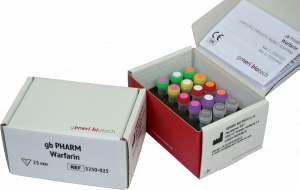
Parameters of the real-time PCR diagnostic kit
- ready-to-use assay
- sample concentration 1-100 ng/µl
- positive and negative controls included
- FAM and HEX channels detection
- identical amplification profile as gb HEMO, gb GENETIC, gb PHARM kits

 ENG
ENG  CZE
CZE 


 Kit for isolation of DNA from body fluids